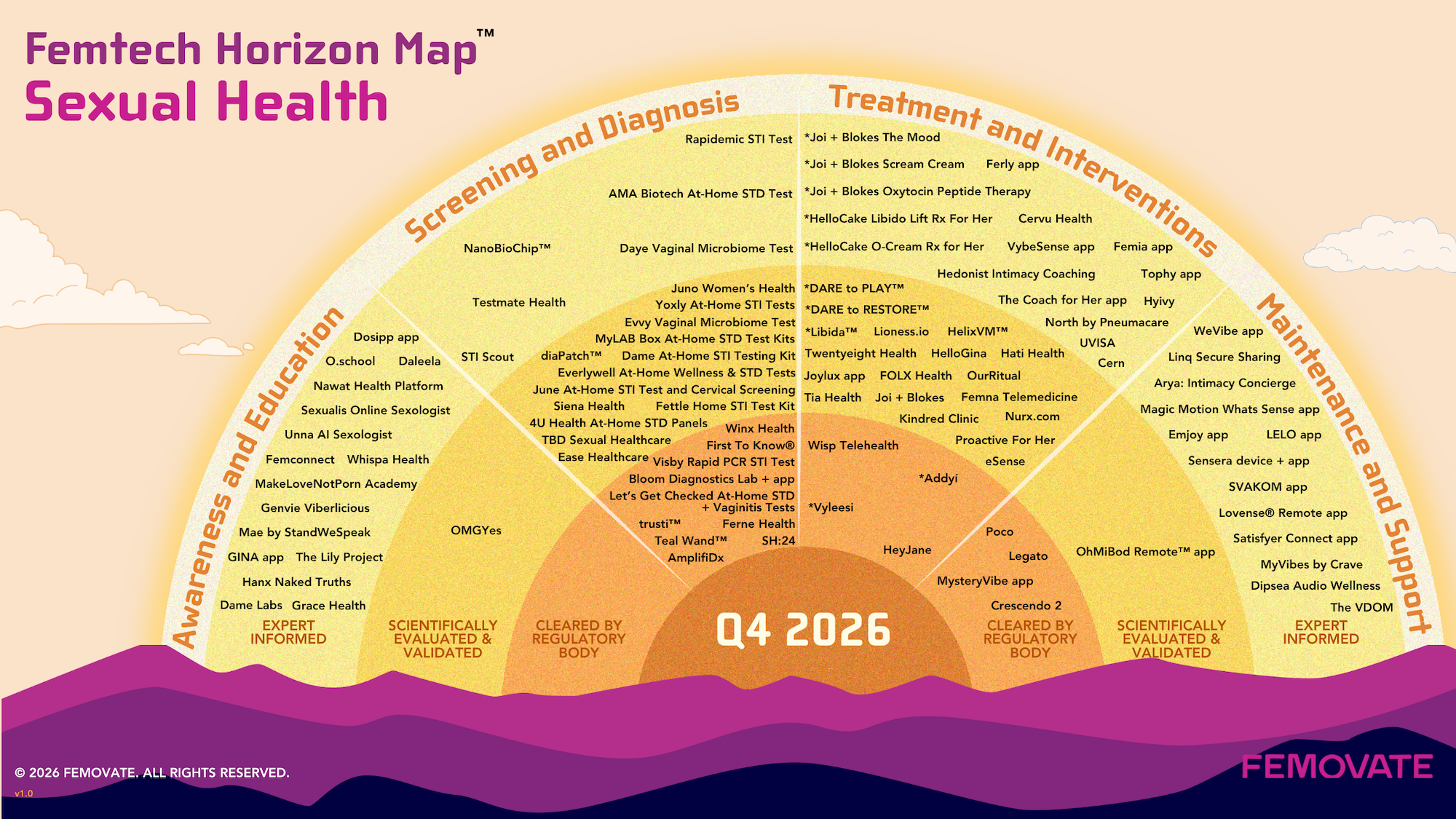
For a category that is blocked from advertising, struggles to raise funds, and is dismissed or deprioritized in clinic and exam rooms, women's sexual health's trajectory over the past three years is astonishing. A wand that screens for cervical cancer without a speculum. A vibrator with biofeedback sensors that tracks arousal over time. An Arabic-language AI sexologist. A prescription arousal cream heading into Phase 3. A line of sexual function devices now distributed through the US Department of Veterans Affairs.
This map shows the innovators and those on the horizon, and importantly, where there is still whitespace.
The lab is moving closer to the patient
Molecular diagnostics are moving out of centralized laboratories and into both clinics and homes. Most of these tests work by copying a pathogen's genetic material until there is enough of it to detect reliably, a method called PCR (polymerase chain reaction) that is the gold standard for infectious disease testing but has typically required a lab and a wait of hours to days. Results that once required a central lab and days of turnaround can now be delivered during a clinical visit or by the patient at home. Visby Medical's Women's Sexual Health Test has FDA De Novo authorization for over-the-counter use and returns results in about 30 minutes. More companies are entering this space too: AmplifiDx , Rapidemic , Scout Health.
The speculum takes a backseat to other screening tools
In 2024 I contributed an article to Forbes called "Shelving the Speculum," and it is validating to see us moving closer to that reality with new products for self-collecting samples for HPV, the virus that can cause cervical cancer. Both a wand and a tampon now work as collection devices, and they are reporting high accuracy. Startups include: Teal Health Health (just raised a $22M series A), Daye , Thyia
And even the swab is up for redesign
For some screenings, even the swab is being replaced by menstrual effluent collection, saliva, and semiconductor biosensors. The analysis behind them ranges from targeted qPCR panels to metagenomic sequencing that screens hundreds of microbes at once. Worth looking at: Evvy (just raised a $40M series B), NOWDiagnostics | NOWDx , Ama Biotech , Glaucus Technology
Sex toys pursue medtech status
Sexual health devices are typically exempt from premarket review, under the FDA's low-risk general wellness policy. But some companies are building and validating them as reimbursable medical devices. Companies are working out the pathways as they go: MV.Health was first to reach HSA and FSA eligibility, in 2022, and lists the US Department of Veterans Affairs among its distribution partners. INTERESTING STARTUPS INCLUDE: MV.Health, Joylux, Inc, SkiiMoo Tech
Chat opens the door in restricted markets
Where sexual health information is culturally or legally constrained, companies are meeting women on the channels they already use, through WhatsApp, chatbots, and anonymous mobile apps rather than clinical portals. Several reach very large numbers of women, even with modest funding. CHAVA (The Lily Project), Mother B, Grace Health , StandWeSpeak , Whispa Health
Telehealth is consolidating
Standalone sexual health brands are being absorbed into broader platforms. More of this reflects funding pressure than expansion: two of the recent targets had already closed clinics or wound down their own platform before the deal closed. Wisp ( TBD Health ), Joi+Blokes ( HerMD ), Twentyeight Health ( SimpleHealth ), Thirty Madison ( Nurx from Thirty Madison )
NHS England began rolling out at-home HPV self-sampling in August 2026, offering kits to 30- to 65-year-olds who have not attended screening after an invitation, with around four million invitations in the first phase. The swab is posted back free, and anyone testing positive for high-risk HPV is invited in for a clinic test. Private digital clinics including Thyia were already offering self-sampling in the UK before the national programme adopted it [1].
Visby Medical received FDA De Novo authorization in March 2025 for the first over-the-counter PCR test for sexual health, covering chlamydia, gonorrhea, and trichomoniasis [2].
Teal Health Care received FDA De Novo authorization in May 2025 for the Teal Wand, the first at-home self-collection device for cervical cancer screening in the US, following Breakthrough Device designation, with SELF-CERV results published in JAMA Network Open [3].
MV.Health lists six devices as FDA-registered Class II therapeutic vibrators, 510(k)-exempt under 21 CFR 884.5960 (product code KXQ), an obstetrics/gynecology classification. The US Department of Veterans Affairs appears among its distribution partners. MV.Health was also the first company we know of to make sexual wellness devices eligible for HSA and FSA purchase, in 2022.
Daré Bioscience, Inc. has announced Phase 3 plans for sildenafil cream for female sexual arousal disorder, supported by a randomized placebo-controlled study in 200 women. It is available now by prescription as a Section 503B compounded product while the company pursues approval [4].
These trends emerged as we've mapped products and services across the continuum of care. The examples below highlight where innovation is gaining traction and where significant gaps remain.
Education platforms and digital communities are delivering what formal sex education did not, and in many markets they are the only available entry point to sexual and reproductive health guidance at all.
Education and content platforms: OMGYES built its product on primary research into women's pleasure. O.school, Dame Labs, MakeLoveNotPorn Academy , HANX , and Genvie provide expert-informed content across education, community, and instruction, while Dipsea and Emjoy have built audio platforms addressing arousal and body confidence.
Education for teens and young adults: Planned Parenthood Federation of America's Roo answers teenagers' questions free and anonymously, with answers backed by its health educators. Amaze, from Advocates for Youth, produces sex education for 10- to 14-year-olds, and Scarleteen has provided comprehensive, youth-centered sex and relationships education since 1998. All three are nonprofit.
AI assistants in restricted markets: This is the fastest-growing category on the map, primarily outside the US. Mother B. delivers Arabic-language sexual and reproductive health guidance through its Daleela assistant across MENA, alongside a clinic in Cairo. StandWeSpeak's Mae serves young women in India, Grace Health operates in Ghana and Nigeria, Whispa Health and FemConnect ZA serve Nigeria and South Africa, and Chava, developed by The Lily Project, reaches girls across Latin America through WhatsApp. Unprude and Nawat Health provide anonymous guidance in their own markets, and North, from Nigeria's PneumaCare , was selected for the UNICEF Venture Fund's gender-responsive innovation challenge.
Screening and diagnostic tools are on the rise for STIs, while unfortunately, sexual health screenings and diagnoses haven't become mainstream yet. See our Femtech Horizon Map for Pelvic Health to see crossover products in this space.
Rapid and point-of-care molecular testing for STIs: Beyond Visby Medical, Ama Biotech is developing menstrual fluid as a sample type, and Glaucus Technology is building a NanoBioChip designed to detect up to 50 STI and UTI pathogens within minutes.
Mail-in and lab-based panels: LetsGetChecked and Everlywell provide at-home sample collection with centralized laboratory analysis, while SH:24 operates at public health scale in the UK, offering free STI testing and treatment.
Vaginal and urogenital microbiome diagnostics: Evvy now finally pairs testing with a care pathway rather than delivering a result and stopping. Daye uses tampon-based sample collection, which removes the swab entirely, and Winx Health has extended into UTI and vaginal pH testing. Perhaps they can pair up with some of these innovative medtech devices for treatment!
Cervical screening and self-collection: In the UK, Thyia built its service around at-home HPV self-sampling, which performs comparably to clinician-collected sampling when a validated PCR-based assay is used. And in the US, Teal Health's Teal Wand was the first at-home self-collection device for cervical cancer screening to win FDA De Novo authorization, and Waters followed with a cleared at-home Onclarity HPV kit in April 2026.
Digital health is spearheading screening for sexual disorders: Clinician-founders are driving this vertical forward: Claudia Chisari, PhD, CPsychol , a health psychologist at King's College London , founded Bloume Health Health, whose app supports women with vulvodynia, vaginismus, and other pelvic pain. And Rosy Wellness, the pioneer in this space and widely used by clinicians and patients, is available again under Intimate Rose after ten months of closure. Rosy was founded by OB-GYN Lyndsey Harper, MD, FACOG, IF and to-date has been widely adopted by clinicians and patients alike.
The treatment landscape spans telehealth care delivery, pharmaceutical therapies, digital therapeutics, and regulated devices.
Sexual health telehealth: Wisp provides diagnosis and treatment following at-home testing, FOLX Health delivers sexual and reproductive care centering trans and queer patients, and internationally, Proactive For Her serves women across India and Siena Health across Southeast Asia.
Pharmaceutical interventions: FDA-approved therapies include Sprout Pharmaceuticals, Inc.'s Addyi (flibanserin) and Cosette Pharmaceuticals, Inc.'s Vyleesi (bremelanotide) for acquired, generalized hypoactive sexual desire disorder in premenopausal women, and Daré Bioscience, Inc.'s sildenafil cream is available by prescription as a compounded product while it advances toward approval. For a condition with nothing in the pipeline a decade ago, this is so validating. Interested in how these drugs even make it to market, dig into the documentary: The Pink Pill: Sex, Drugs & Who Has Control.
Digital therapeutics and sex therapy: HelloGina delivers structured programs with human coaching for vaginismus and penetrative pain, while Ferly and OurRitual address desire, intimacy, and couples therapy.
Devices for sexual function: MV.Health has advanced furthest through the available regulatory routes, with HSA and FSA eligibility. The published work it points to in female sexual arousal disorder is a 16-woman conference abstract pairing a Crescendo device with CBT sessions, not a controlled trial of Crescendo 2. Joylux, Inc's vFit+ applies red light therapy under a low-risk general wellness designation, and the clinical study behind its validation claims was run on vSculpt, a related device. An exciting new entrant in this space is SkiiMoo Tech's VDOM, a prosthetic genital device for restorative and affirmative care, founded by Glenise Kinard-Moore.
As sexual health product offerings mature, longitudinal support will be needed on two fronts, and there is plenty of opportunity space on both. Infection history, microbiome composition, and treatment response need to carry forward so that recurrence is managed rather than re-diagnosed each time. Sexual function is a different track, where desire, arousal, and pain shift with life stage, medication, and surgery. Almost nothing is in place to follow sexual function over time for women, with the exception of a few connected devices with data capability. Lovense-AL, the Lovehoney Group (We-Vibe and Womanizer), and LELO have distributed connected intimate hardware with companion apps at consumer scale. Lioness Health is another connected device with data capabilities, applying biofeedback sensors to record pelvic floor contractions and track arousal and orgasm patterns over time. Together these are the largest deployment of intimate sensors anywhere in women's health, but it is unclear if and how this data is being used for health research and interventions.
Sexually transmitted infections remain the largest volume problem. More than one million curable STIs are acquired every day worldwide among people aged 15 to 49, with roughly 374 million new infections across chlamydia, gonorrhoea, syphilis, and trichomoniasis in 2020 [5]. In the US, reported cases of chlamydia, gonorrhea, and syphilis declined 9% in 2024, the third consecutive year of decline. Congenital syphilis, however, increased for the twelfth consecutive year [6]. Adult infection rates are improving while transmission to newborns keeps rising, which points to a gap in education and access not necessarily in testing technology.
Sexual health screening is now directly linked to cervical cancer prevention. Roughly 300 million women worldwide have an HPV infection, and HPV is associated with more than 311,000 cervical cancer deaths each year [5]. The movement for at-home sampling kits may turn this tide.
Vaginal and urogenital infections are the next largest volume problem. Bacterial vaginosis affects roughly a third of US women of reproductive age, most of whom have no symptoms, and more than half of treated women see it return within a year [7]. Candidiasis and UTIs follow the same recurrent pattern.
Female sexual dysfunction, despite gaining little recognition, may be one of the highest-value opportunity spaces on the map. More than 43% of women reported a sexual problem in the PRESIDE study [8]. Sexual dysfunction overlaps with several other Femtech Horizon Maps to date. Painful sex is covered in our Pelvic Health map, genitourinary syndrome of menopause in our Menopause and Perimenopause map. But those maps also show a gap in education and awareness, and screening and diagnostics.
The map is crowded at the point of diagnosis and thins out quickly after it. The gaps fall on either side of the two categories in this map, and they are not the same problem.
Infection
Sexual function
One gap sits ahead of both. Education for teens and young adults exists, but it is almost entirely nonprofit driven, with the exception of the new MakeLoveNotPorn Academy a global aggregator hub by Cindy Gallop and team that makes the best of the world’s sex education easily searchable and accessible for every age.
Regulatory precedent. Two novel pathways opened in 2025, one for over-the-counter molecular testing and one for at-home cervical screening.
Classification is shifting. Sexual function devices reaching HSA and FSA eligibility and federal distribution suggest this category is beginning to be perceived as medical rather than consumer wellness, which is the precondition for insurance coverage.
Awareness apps are growing fastest outside the US and Western Europe. Chat-first models are scaling in markets where care is difficult or impossible to access. We expect to continue to see novel ideas emerge from these markets, where resource constraints fuel innovation.
Fighting Censorship. A 2025 Center for Intimacy Justice analysis of 159 women's health organizations found the majority had advertising rejected across Meta and other major platforms for standard anatomical and clinical terminology, while erectile dysfunction advertising is not similarly restricted [9]. The ongoing fight against censorship needs more funding and voices.
Reimbursement needs to cover monitoring and maintenance, not only episodes. Reimbursement built around a single visit cannot fund the longitudinal care that recurrent infection and sexual dysfunction require.
Clinicians have to raise these subjects. More than 40% of women report a sexual problem [8], yet a health-system study of 369,647 women found only 4% were ever diagnosed with female sexual dysfunction, against 10% of men diagnosed with erectile dysfunction. The authors describe clinicians as hesitant to "open Pandora's Box" and report that primary care physicians feel underprepared to manage what they might find [10]. Medical school education and professional development needs to evolve and expand into this space.
International investment is needed. More than a third of the companies we mapped serve MENA, sub-Saharan Africa, South and Southeast Asia, and Latin America on very little capital.
The Femtech Horizon Map for Sexual Health is a starting point for identifying these opportunities and accelerating meaningful progress in women's health. Comment to share your thoughts and increase reach.

Fueling femtech innovation with design capital and strategic support for early-stage women’s health startups