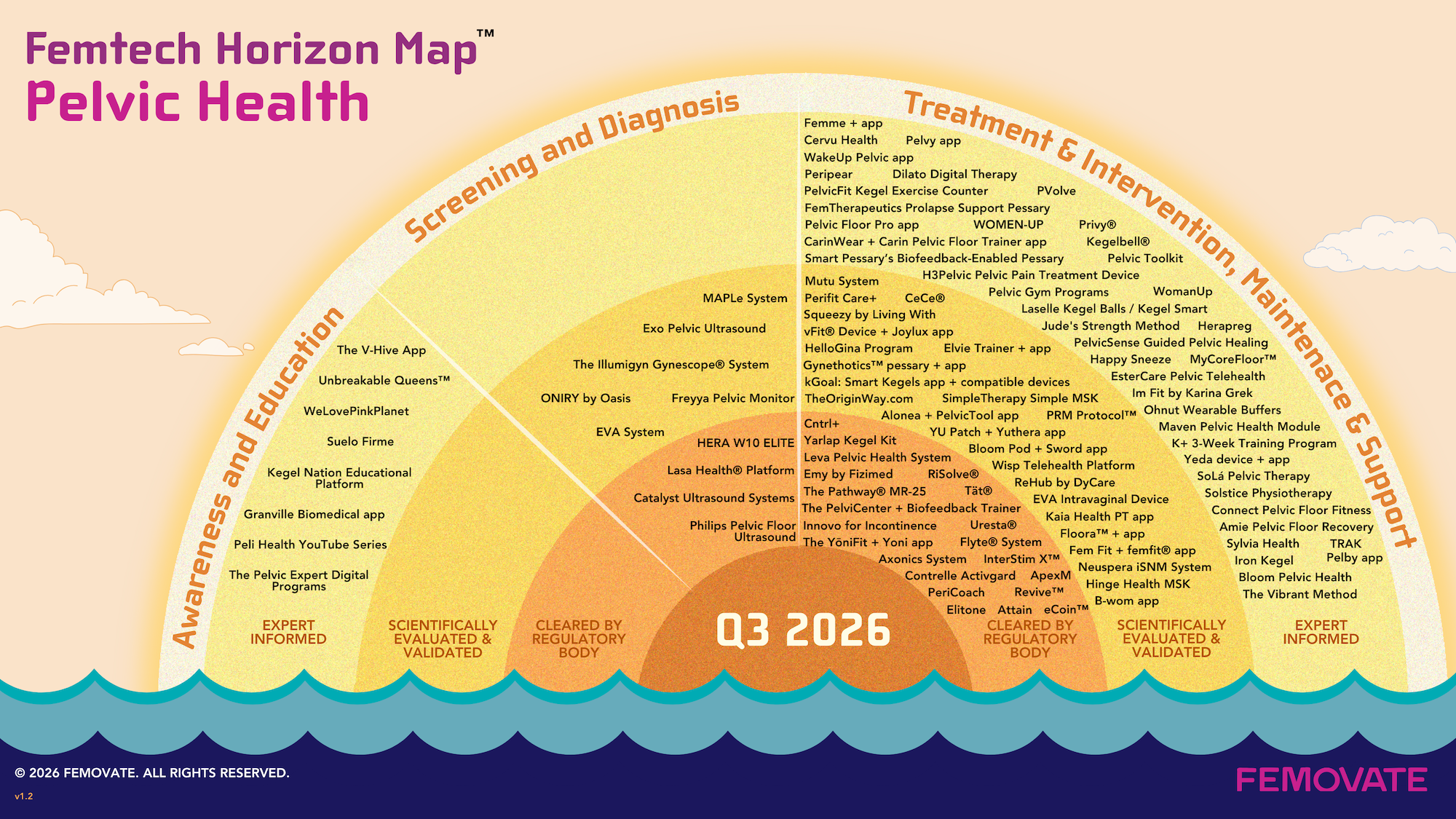
Pelvic health is now one of the most prolific verticals in femtech. Across incontinence, prolapse, chronic pelvic pain, and painful sex, founders have built smart trainers, digital physical therapy, neuromodulation, redesigned pessaries, at-home therapy, and dozens of FDA-cleared and CE-marked devices. For a set of conditions long dismissed as untreatable, the solutions already exist.
And yet women are still struggling. One in four women in the United States lives with at least one symptomatic pelvic floor disorder [1], chronic pelvic pain affects roughly one in seven [2], and painful sex an estimated one in five [3]. Most of them never reach the companies on this map. The problem in pelvic health isn't lack of invention, it is normalization and access to the right care and products.
Multiple forces are preventing widespread adoption of these solutions. Many women do not know these conditions are treatable, and the companies built to reach them are barred from naming women's bodies in their own advertising. Awareness and education, the critical first part of the continuum of care is stymied by a reluctance to talk about these issues.
For this map, we examined four phases of clinical need, Awareness & Education, Screening & Diagnosis, Treatment & Intervention, and Maintenance & Support, and mapped each company by level of clinical validation. Innovation concentrates in treatment, while awareness and diagnosis, the phases that bring women into care in the first place, stay thin. That pattern is what separates pelvic health from fertility and menopause, where each rode a wave of public awareness into the clinic. Pelvic health needs a moment too.
This is where pelvic health diverges from other major femtech verticals. Menopause has celebrities, best-selling books, and employer benefits. Fertility has a decade of consumer brands and private equity investment, maternal health has social impact funds and philanthropies. Pelvic health has almost none of this. A small group of educators carries the entire load: Sara Reardon's The Vagina Whisperer and its V-Hive app, The Pelvic Expert, Kegel Nation, Granville Biomedical's anatomical models and companion app, and WeLovePinkPlanet, which trains both women and the clinicians who treat them. Their work is excellent, and we need more of it.
The consequence is normalization: leaks, prolapse, and pelvic pain are treatable medical conditions, but women assume they are the ordinary price of childbirth and aging. 81% believe exactly that, and only 15% of those with symptoms recognize they might have a treatable condition [5]. Awareness is the thinnest phase on this map, and it is the one every other phase depends on.
Diagnosis is nearly as empty, and much of what exists was borrowed from general gynecology rather than built for the pelvic floor. The clinical mainstay is imaging: EXO Technologies pairs a handheld ultrasound with its SweepAI system, Halo MedTech offers multi-compartment ultrasound designed for pelvic floor specialists, and incumbents like Philips and Samsung supply the platforms most clinics already own. A smaller set is purpose-built for pelvic floor function. Novuqare's MAPLe reads muscle activity through a multi-electrode probe, ONIRY by Oasis uses machine-learning impedance spectroscopy to catch obstetric anal sphincter injuries in the minutes after delivery, and wearable monitors from Freyya and Sallie Health track activity at home. Earliest of all are the symptom screeners, where Lasa Health uses AI to surface likely endometriosis from patient-reported symptoms and Isa applies the same approach to broader pelvic assessment.
Early screening is just not part of the standard of care though, set up to catch pelvic floor dysfunction before a woman has spent years assuming her symptoms are normal.
Treatment is where the map is dense, and it runs along three approaches. Sensor-based trainers from Elvie, Perifit, PeriCoach, and JUNOFEM's femfit turn an invisible contraction into visible data, solving the oldest problem in pelvic floor exercise, that most women cannot tell whether they are doing it correctly. femfit reports resolving up to 80% of urinary incontinence symptoms. Neuromodulation and mechanotherapy deliver clinical results without surgery, from implants by Medtronic and Boston Scientific to non-invasive devices from Elidah, Caldera, and Pelvital. Structural support is being reinvented through Cosm Medical's 3D-printed pessaries, Ctrl+ and over the counter offerings. Larger platforms including Sword Health, Hinge Health, and Origin now fold pelvic care into musculoskeletal and women's health programs, bringing employer and payer distribution to a market that has been largely consumer-funded.
The evidence behind these products varies widely. At the expert-informed end sit app-based Kegel programs from builders like PelvicSense and Pelvy, valuable as direct to consumer solutions for women who know what they need already. In the middle are clinically supported tools such as Perifit, Renalis, and Joylux. At the regulated end are cleared devices including Axena Health's Leva, Pelvital's Flyte, PeriCoach, and eContinence's Tät, the first incontinence app evaluated in a randomized clinical trial. We mark each company by validation tier on the map so the distinction is visible at a glance.
Chronic pelvic pain and sexual pain carry heavy quality-of-life burdens, yet they stay underfunded next to incontinence, where willingness to pay and device pathways are clearer. The builders here are early and worth watching: Dilato and PelvicSense for pelvic and sexual pain, Ohnut's wearable buffers, Hyivy's Floora rehabilitation device, and Cervu Health, which supports cancer survivors navigating changes to sexual health.
Many of the treatment and intervention solutions provide maintenance and support, so we combined these two sections because of the consistent crossovers.
The biggest opportunities on in pelvic are starkly visible by looking at the map density. Awareness & education tech must expand and early screening & diagnoses must become the standard of care across key life stages: puberty, childbirth and postpartum, perimenopause. The de facto advertising ban suppresses the messages women need to hear at each stage. A 2025 Center for Intimacy Justice report found that 84% of women's health brands had ads rejected on Meta, often for words as basic as "pelvic floor," "vagina," or "menopause," while male erectile dysfunction ads run freely [6]. Pelvic health companies on this very map, including Joylux and Wisp, have had campaigns blocked. The companies most motivated to teach women that these conditions are treatable are the ones being silenced.
Incontinence has been the commercial anchor of pelvic health, with the urinary incontinence devices market projected to grow from about $4.2 billion in 2024 to roughly $8 billion by 2030 [7]. The larger opportunity sits in the conditions it has overshadowed. Chronic pelvic pain, sexual health, and pelvic recovery after cervical and other cancers are all underbuilt relative to how many women they affect. The rest of the whitespace is awareness that reaches women before their symptoms are dismissed, earlier screening, and the payer and employer channels that turn consumer products into covered care.
Silos between clinical and consumer, and silos across the continuum of care, and silos across the stages of life are the white spaces in pelvic health. The opportunity is integration: Building platforms that supporting a woman from puberty to menopause, screening at key points in her life, into validated clinical care in the office and in the comfort of her home, helping her build pelvic health to last through her lifetime. Sword Health, Hinge Health, and Origin are early models of that bridge between consumer wellness and clinical care, but are reactive solutions, not preventative. The next phase of pelvic health will belong to the builders who connect the continuum, not to those adding one more product to an already busy market.
To everyone who contributed to this map through LinkedIn. We published the draft list of companies our founder, Theresa Neil's, newsletter "Imagine the Future" and so many people responded with support and more companies to include.
Our Femtech Horizon Maps highlight technologies across women's health, showing where innovation is emerging and where gaps remain. By visualizing the full continuum of care, they help founders, clinicians, and investors identify opportunities and build more integrated solutions. This is one of twenty (20!) maps in our series.
Femovate is a women-owned, women-led company specializing in product strategy, design, and validation for women's health solutions. If you are building in pelvic health, our team can help bring your innovation to market. Reach out through LinkedIn or our website to collaborate.

Fueling femtech innovation with design capital and strategic support for early-stage women’s health startups